A history of my ears
Back around the year 1995 I was diagnosed with Meniere's and I now have what is known as bilateral Meniere's (i.e., both ears are affected). As the title of the post suggests; this is going to be all about my ears and how Meniere's has affected me (balance, hearing and life in general). This is a 20+ year history of my experiences living with Meniere's. I am expecting this to be a long post. I wanted to put a post together and document it. It's difficult to explain to family, friends, and, work colleagues. I have intentionally removed identifiable information, such as my location, my job, family details, medical personnel and so on. If anyone wants to contact me you can use the following email address: audioear@proton.me
Meniere's is a complex condition. I have found Dr Timothy Hain's explanation the most accessible and complete information on the internet. He is always up to date with the latest research. Have a look at the detail provided by Hain to get the medical perspective. For this post I focus only on my experiences, my history and the current state. Let me start by saying;
There is no cure.
I plan to touch on the following:
- How it started for me and my History
- Balance
- Hearing
- Reading audiograms
- My hearing audiograms
- Hearing Aids
- Tinnitus
- Remission
I will finish with the current state and looking forwards and I also add some general items.
How it started for me and my History
In the early 1990's I started hearing ringing in one of my ears, initially this ringing only affected one of my ears. At the early stages this was pretty much my only complaint. My hearing was not affected and my balance seemed to be fine. My local GP put me in contact with a local ENT consultant. He completed the usual audio tests and sent me for an MRI. All seemed generally OK, so we ignored it for a bit. A few years later I started having other symptoms, such as, balancing problems, a more pronounced ringing in the affected ear, a "fullness" in the ear, along with fluctuating hearing loss. Over the years, I have attended more ENTs than I can remember. Remarkably, one ENT noted that I knew more about Meniere's than he; I still had to pay the consultancy fee!
It's important to highlight, the condition is idiopathic (i.e, medically unknown), and, that there is no cure. When reading about the condition (such as research papers and so on) coupled with knowing that Meniere's is individually heterogeneous, one ENT observed that the efficacy of research needs to be 90% - 95% in order for a cure to really be considered a cure. This actually makes good sense as the condition tends to be unique over time per person, and there is a "randomness" to it all. Such conditions would make it difficult to complete medical studies.
Let's have a look through some of these symptoms.
Balance
At the early stage and without doubt, balance was the most debilitating of my symptoms. I was experiencing general balance problems but also what are known as drop attacks. Have a look at this drop attack captured on video. I had about 7 - 10 of these over a ~3 year period in my early stages.
The way I explain drop attacks to someone;
Let me wrap a headband around your head, then, let me stand behind you. I will attach a heavy stone to the headband. You can not see me, you can not see the heavy rock, but it's there. I then just follow you around, and, without warning, I drop this heavy stone. The dropping of the stone is either swift (i.e., just drop it), or it might be slightly more gradual but still generally swift. All happening in seconds. You are now either on the ground or you have hit your head against some object such as a table. If you are unlucky to be driving, you could be in serious danger. You have no way of stopping this. If the experience is a little more gradual, it's more like someone pushing your head towards the ground; literally push someone's head towards the ground, they have no way of stopping this.
Has it happened to me while driving? Yes, twice.
Lucky I did not have a serious accident, but it was a serious issue. I knew what was happening, and I somehow managed to prevent a serious accident. I do recall one of these times that my forehead was actually on the steering wheel, literally, my forehead was against the steering wheel, and, I could not lift my head up. The car was still travelling at 60 - 70 kms. Somehow my brain kicked in and it knew what was happening, and by some miracle my brain had an awareness of what was around me. I guess simply based on memory from the previous few seconds travelling down that road. I knew it was quiet, I knew the road, I knew I could direct the car to the side of the road. I had to constantly tell myself, and repeat, I know where I am, I know there are no cars, gradually apply the breaks (I felt I needed to slam on the breaks, which would have been the wrong course of action). For these few seconds I had to "judge and hope" while moving the car over to the side of the road. I basically drove blind for about 10 - 20 seconds going from ~70 kms to 0 kms, all without warning.
Outside of these drop attacks, I suffered significant balance issues, very often and quite frequent, I would have to crawl in order to move. I had no chance of walking. With these balance issues, if you attempted to move your head you would often vomit, so you really do not want to actually move, and often, you just have to lie down and keep your head as stationary as possible, all while the entire outside world is spinning around. Such balance issues could last between 10 minutes to several hours. The longest period that I can recall was about 7 hours. There was never any consistency to length of time.
The balance problems would occur randomly, you might have a "sense" that something is about to happen based on other symptoms such as, fullness in the ear, tinnitus or fluctuating hearing loss, but you may not have this "sense". The issue with this "sense", is that these symptoms are regular so it's not as simply as I have a few symptoms so let's just lie down for a bit. While the balance problems would last 10 minutes to several hours, the symptoms would be permanently hanging around.
Fast forward to today, and luckily, I no longer have these drop attacks and I tend not to have deliberating balance issues. This is primarily because from all these "balance attacks", my balancing hair cells in the inner ear are effectively dead. This is often considered late stage Meniere's, some refer to this as burn out.
So, how do I actually balance?
I now rely primarily on my eyes to balance, and other body touch points, such as my leg position, angel of back, arms, and so on. My balance is crap, but it's manageable, I struggle to run swiftly as my eyes find it hard to focus on fixed points. Recently at a work event I was following a small ball in the sky while briskly walking backwards, trying to catch the ball, I felt like I was > 100 years old. I caught the ball though!
Overall, my balance is not a daily complaint I have right now, and that is certainly a positive.
Hearing
With Meniere's your hearing fluctuates, and over the years this has come to affect both my ears (as I am bilateral Meniere's). In the earlier years, this primarily affected only one ear (and was manageable). I could lose hearing in one ear for a few hours, to a few weeks to several months. During these time periods my hearing in the affected ear would continually fluctuate, often changing within within 10 - 20 minute windows, and this could happen several times in the day, and be different every day, so pretty much random. I could be in a meeting and be reasonably OK with my hearing (i.e., I would manage), and then, 30 minutes into the meeting, hear nothing. Over this 30 minute window my hearing would gradually decline right down to the point of not being able to hear from the affected ear. This was all in the early days, I would manage with one ear. The fluctuating hearing is so damn annoying especially when you are bilateral. It's like giving a volume control to a baby and they randomly pressing the - / + buttons.
Pretty quickly, I became bilateral and hearing affected both my ears. The earliest I can recall both ears being affected was sometime in the early 2000's (you can see this in my hearing audiograms). That would mean within ~7 years of my initial Meniere's diagnosis, my hearing in both ears was affected. While my hearing would fluctuate, I could still "manage", you tend to learn how to deal with various situations, e.g., you would try to have meetings at times that you typically have good hearing, you would cram all phone calls into a time window that your hearing was good. I might only need to pick up a few words to know the context, I would "read" the situation before attending meetings, and I would try to get as much information about the meeting before attending. This is one reason why I ask many questions before a meeting, and, why I try to soak up as much information beforehand.
This fluctuating hearing in both ears went on for several years until around 2011. I distinctly recall, one day while driving out of a garage, my right ear started hearing a very high pitched frequency and then "bang!", yes a bang, or some sort of pop noise, and then nothing. 12 years later, I have heard nothing in that ear (profoundly deaf in the right ear, i.e., a hearing aid is of no benefit). Since 2011 my right ear was considered the bad ear, while the left ear was known as the good ear. From 2011 to about 2017 "the good left ear" continued to fluctuate. In simply terms, I may or may not be able to facilitate a phone call with my "good ear" even with a set of headphones, I would simply not hear you, again I had to figure out how to manage. I did manage, and I am sure I annoyed a lot of people over the years as I have found this so frustrating, it was a persistent daily thing. So, from 2011 to 2017 I managed, but it was exhausting at times, on a daily basis not knowing when my hearing would be OK, and then in 2017 I went into Remission until 2022.
Let's have a look at some of my hearing audiograms, first I will briefly explain how to read an audiogram, and then I will chat a little about hearing aids.
Reading audiograms
There are a few basics to reading an audiogram report. Below is a basic audiogram with additional information that I overlayed onto the graph. Hopefully this will help you read my audiograms. Just note that, audiograms are only one element of a hearing assessment, and they are often called a Pure Audio Test. This part of a hearing assessment is "ballpark" stuff, just to get a sense of one's hearing. I am intentionally ignoring speech discrimination and ear pressure and so on.
On the left and vertically positioned, there is the volume (i.e., the decibels), the volume increases as you go down the graph, +10db, + 20db and so on. On the top and horizontally positioned the frequencies are represented. The frequencies go from a low frequency (such as a car) to a high frequency (such as a bird chirping). Sometimes the frequencies appear along the base on the graph.
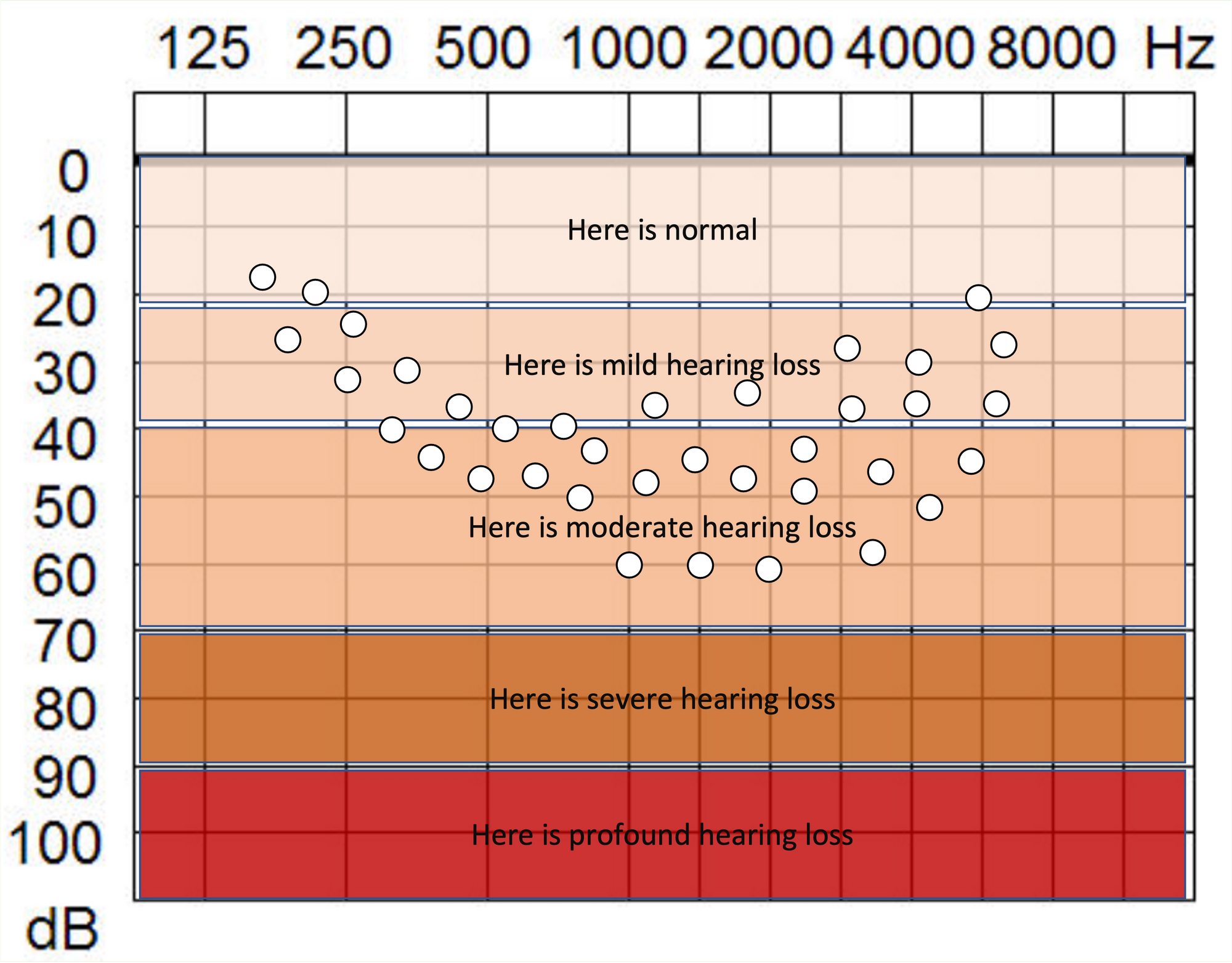
I added the white dots to give a rough idea where speech is. This pretty much means where human conversation takes place, and if you are entirely outside of that white dot range you will struggle to hear human conversations.
The audiologists sets the frequency and the volume. If you hear the frequency at the set volume, the audiologist marks the spot on the graph to indicate that you hear the frequency at that volume. They usually mark a O for the right ear, and an X for the left ear. It's all pretty simple, and, as I say this is a "ballpark" hearing assessment.
In the above audiogram image I also indicate the hearing loss severity; normal, mild, moderate, severe, and, profound. Let's take an example of severe hearing loss for a specific frequency. Take the frequency 2,000; you would have a severe hearing loss if you required the volume to be increased by +70 db / +90 db. This frequency is also within the range of human conversation, and so, if you have hearing loss in this frequency you will struggle to follow conversations that hit this frequency.
Briefly on Speech discrimination; it's important to point out that, simply turning up the volume does NOT solve the problem. The question for me is all about understanding speech (not just hearing it), you need to understand it. A more indepth hearing assessment includes speech discrimination analysis, i.e., understanding spoken words, or, can you understand the sentence with and without lip reading, both in noisy and quiet settings and so on? A detailed hearing assessment can take up to 2 hours. Below I outline all my audiograms tests going back to 2003.
My hearing audiograms
Over the years I have captured as many hearing assessment reports as possible. These reports provide a history of my hearing decline.
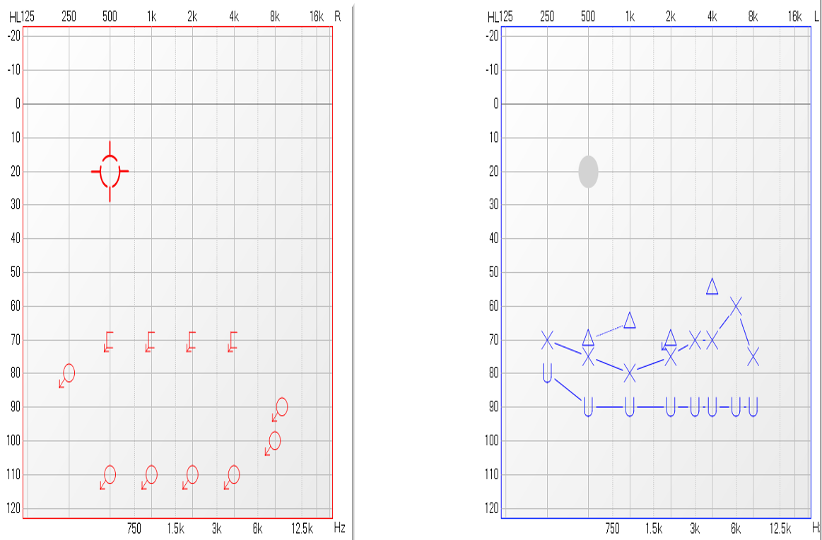
I start by showing my most recent hearing test from July 2022. (I have always found it odd that audiograms present the right ear on the left and the left ear on the right of the report, this seems pretty ubiquitous, and I continue this oddity). Sometimes they present both ears overlayed on 1 graph, and so O represents the right ear, while an X represents the left ear. You will see that my right ear has been profoundly deaf since 2011, while my left ear declines over time.
The summary of hearing decline is; I am profoundly deaf since 2011 in my right ear (no changes at all there), my left ear has continued to fluctuate over the years 2011 - 2017. My left ear went into remission for ~5 years, and now, my left ear has severe hearing loss.
2022
This first image is my most recent audiogram result. You can clearly see that my right ear (in red) is profoundly deaf. The graph is simply saying that there is no response from the ear at any volume in any frequency. While my left ear (in blue), shows severe hearing loss across all frequencies (except for a little bump around the 7,000 frequency range). So, this is the current state of both my ears. If you overlay the range of human conversation onto each of these graphs you can get a sense of how difficult it would be to understand and follow conversations.
Over the years, there is only 1 other audiogram that presents similarly, and that was in 2016. Having said that, the current 2022 results show severe hearing loss in the left ear, while 2016 demonstrates moderate left side hearing loss. There is however something positive here, i.e., the hearing in my left ear did improve to the point of being in remission from 2017 to 2022. However, there is no way of knowing at this point if there will be significant left sided improvements.
2018
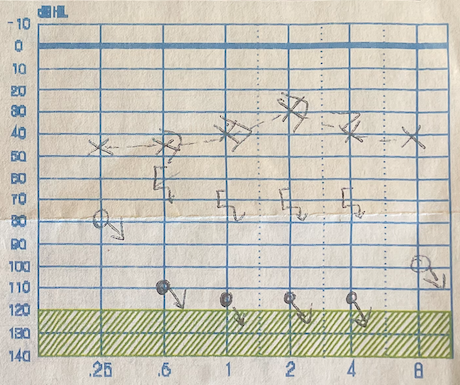
Prior to 2022, my previous hearing assessment was 2018. As I was in remission I had no real need for such tests. Let's look at the left ear (marked by an X), and compare this to 2022 (frequencies are at the bottom in this graph). In 2018 I average a loss of around +40db / +45db across all frequencies. Looking at the 2022 graph, there is nothing registered in the +40db volume for any frequency. Also remember where range of human conversation is. This 2018 audiogram for my left ear would indicate that I should be reasonable OK for human conversation, and that would be correct (as I was in remission), still getting nothing from my right ear, marked with O on this graph. There is a remarkable difference in my left ear between 2018 and 2022 across all frequencies.
2017
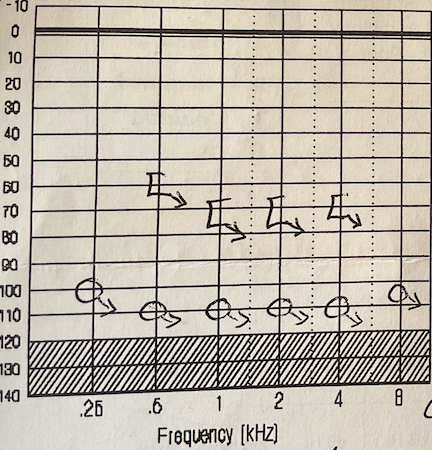
Very similar results to 2018, the right ear is dead, while the left ear has good function in the range of human conversation. This is when I started my remission phase.
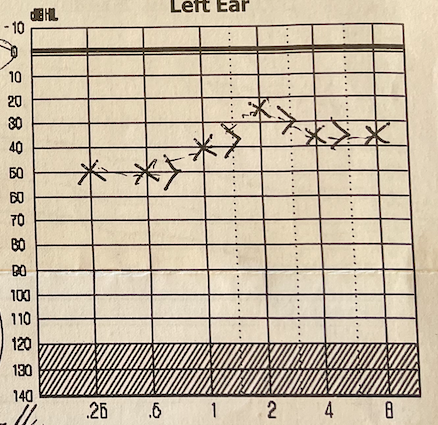
2016
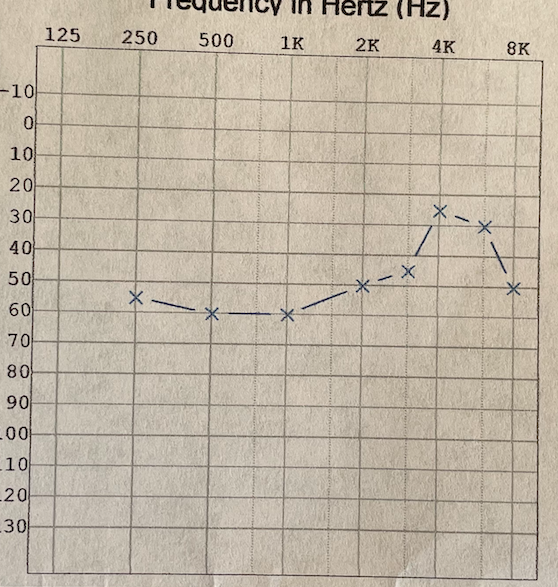
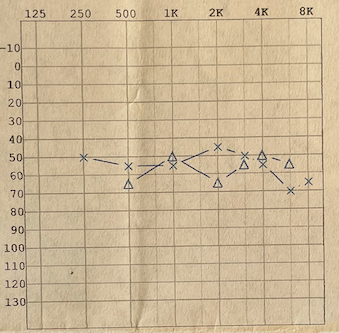
I have omitted my right ear as it continued being profoundly deaf. Below are two tests from 2016 for my left ear. The image on left is in March, and the image on the right is in October. Clearly there is a difference in the 4,000 - 7,000 range; the most striking is at 4,000 (from +25 db to +55 db) and at 7,000 (from +30 db to +70 db). Over the years my left ear held "steady" until October 2016. These graphs continue to demonstrate the changes in my left ear.
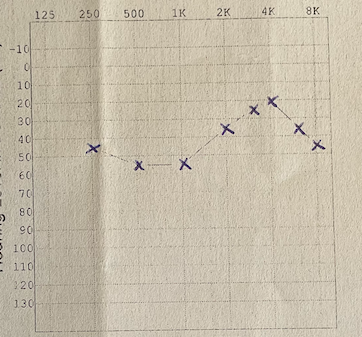
2014
Again just my left ear, this is somewhat similar to 2016, March. Though this 2014 results would be considered better than 2016.
2012
Again only the left ear and similar to 2014.
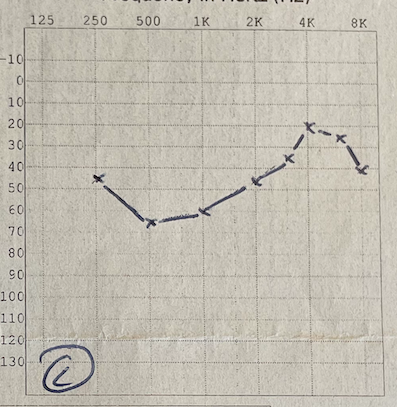
2011
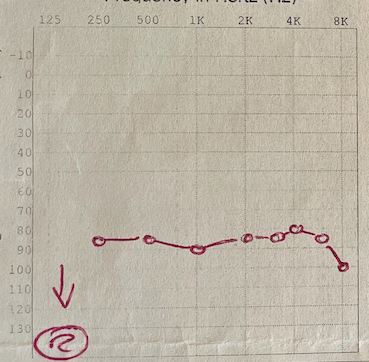
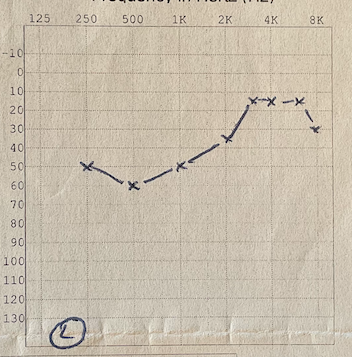
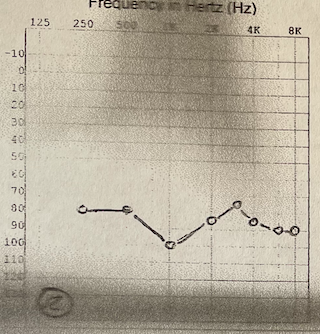
It was 2011 when my right ear became profoundly deaf, and this is the first time I have this captured in an audiogram report. The left ear is within the mild hearing loss range in the higher frequencies and moderate hearing loss in the lower frequencies. My right ear in March 2011 was touch and go to be considered profoundly deaf. As the 2011 July image shows my right ear was pretty much dead.
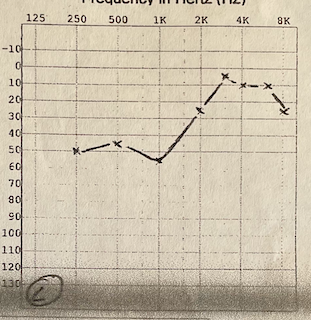
2008
This is the "most recent" audiogram that shows my right ear NOT being profoundly deaf. The right ear is marked with O and the left marked with X. The left ear is pretty good, with some mild hearing loss in the higher frequencies, though moderate hearing loss in the lower frequencies. My right ear had moderate hearing loss in the low frequencies and moderate to severe in the higher frequencies.
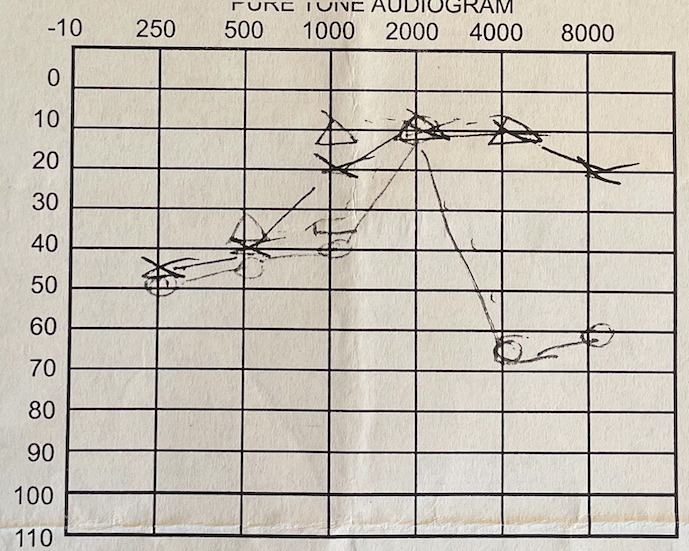
2007
The right ear is similar to 2008, while the left ear has a remarkable difference at the 1,000 frequency between 2007 (+45db) and 2008 (+20db), and so demonstrates that my left ear somewhat improved.
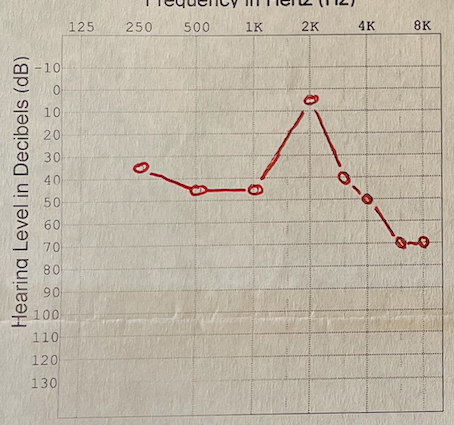
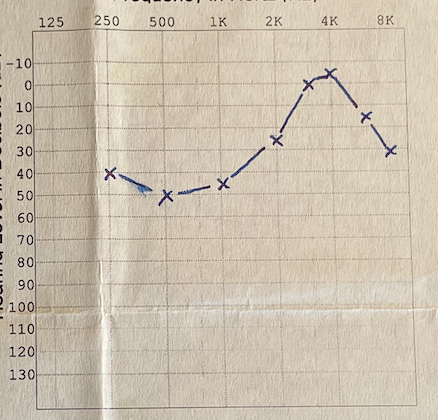
2003
This is the first audiogram that I managed to record. Both the left and right ears are mirror images. Bilateral moderate hearing loss in the low frequencies, and mild hearing loss in the higher frequencies.
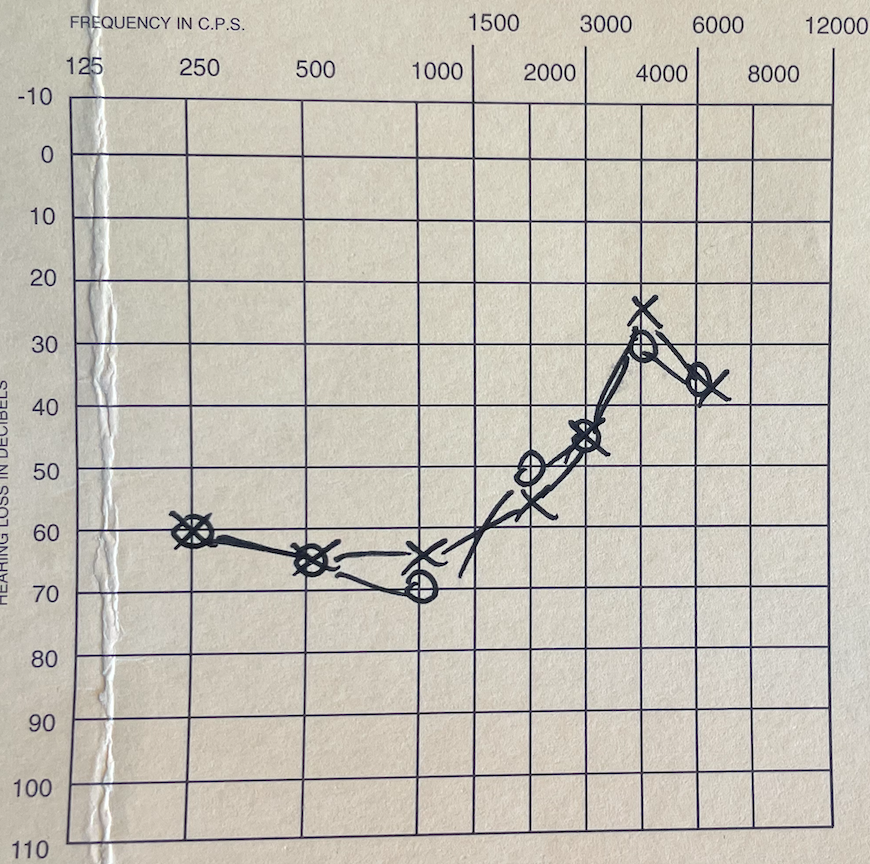
That's all I have on my hearing assessments, clearly the right ear is prfoundly deaf, the left ear fluctuates over time.
Hearing Aids
Have hearing aids helped me over the years? Yes.
But only in my left ear, and, based on my experience they are limited. I never managed to function with two hearing aids at the same time, this was primarily due to the fluctuating nature of my hearing, and simply not being able to get the "right fitting" that could accommodate my situation. So, I have not had stereo sound for 20+ years.
I said hearing aids are limited what do I mean?
A hearing aid effectively increases the decibels in the frequencies that your audiogram has identified as being diminished. In my experience hearing aids are crap with background noise, for example wind is a terrible experience, and I was never able to use a hearing aid in a restaurant setting. Hearing aids for me are terrible when dealing with "complex" sounds. They were good in 1:1 and up to 1:3 settings where there is no background noise. I would always take out the hearing aid in a restaurant, going on a plane, forget about it, out it came, driving in a car, again, take it out. Walking down the street, most often I would take it out, as there was far too many complex sounds. It's very possible that this was related to auditory recruitment for me. Complex sound is just a term I use to describe when there are lots of sounds, it really is amazing what the brain can do with sound and how it tunes and filters to various sounds.
How many hearing aids did I purchase? Last time I counted, I had 7+. I spent a considerable amount of money on hearing aids. One high end hearing aid will cost you about 2,500+ euro. I am guessing, but I don't think I would have had much change from 25,000 euro over the years.
They have helped for sure. Hearing aids are not like putting on a pair of glasses and bingo you see, at least for me they are not. My right ear gets no benefit from a hearing aid.
Tinnitus
For as long as I can remember I have had constant ringing in both my ears. It's terrible when you begin to think about your tinnitus, but somehow you get use to it. I guess this is why you would most often see me wearing my headphones, a method to cope with tinnitus is to "distract" the brain and inject other sounds. My tinnitus is always on. For me, even though my hearing is terrible, there is NO such thing as quiet i.e., hearing nothing, I never "hear" nothing, I hear ringing in the ears all the time and I hear sounds but I can not distinguish these sounds. The tinnitus pitch varies, typically it's in the higher frequencies.
Remission
I still recall two situations (both in 2017) that made me think, is this "Remission" for me?
One was in San Francisco at a conference, and another in Oxford University. In San Francisco I was at a conference attending one of the many 1 hour talks (always there early to get the seat that suited my hearing), typically my hearing would decline during the hour, but this time it did not. And over the next 48 hours during the conference it remained stable, i.e., the same hearing throughout the day, this was just magic. That same year I was in Oxford University listening to a Professor talk for an hour and again recalling, I think I heard pretty much everything they said without my hearing aid, again this was magic.
And so, in 2017 my hearing symptoms went into "Remission", and I could manage without a hearing aid, this lasted for ~ 5 years; until April 2022.
I should point out what I mean by remission. During this remission phase my hearing in my left ear would have been considered mild to moderate hearing loss (still remembering my right ear has never improved). I did not have normal hearing, but it was good and much more manageable. I continued to have mild to moderate hearing loss during this window, I could however comfortably manage a phone conversation, and be generally fine at social events (to a point), again managing situations such as my wife sitting on my right side, and I ensuring that everyone is on my left side and so on. Having said that, I would have been terrible at hearing the TV and would require headphones to listen to the TV, but that was all OK, a pain, but manageable. Going to a concert was no good, I would pick up just noise, but not the music. If I was in a large auditorium where sound reverberates all over the hard walls I would pick up nothing (there is no surprise why there are nice soft curtains in a movie theatre). This was all during my "Remission" phase. This remission was very positive.
The current state and looking forwards
In April, 2022, unfortunately "Remission" ended. I was back to fluctuating hearing loss in my left ear, this was a real downer. For the months of April, May and most of June my hearing regularly fluctuated, but it was still manageable. I would get up at 6am, complete some intense cycling and about 3 hours later I was OK to go on calls, and for the most part, the day would go OK. Having said that, several times during these months, the hearing would just go. Again, following that 30 minute window I previously mentioned, and again, you are back to just managing the situation as best you can.
This brings me right up to 1st July, 2022; waking up (I just knew it was different on that morning), again going for a cycle at 6am, but this time, no improvement. Every sound was muffled, distorted, everything. I just didn't want to hear any sound, my preference at this point was just for my left ear to process no sound. Hearing all distorted sound is one of the worst sensations I have ever experienced, it's just horrible. By 10am there was still no improvement, my wife contacted my ENT, and he had me attend his clinic immediately. My ENT is great, previously he gave me an "SOS card", for such a situation. This allowed me to get to see him instantly.
The ENT's diagnosis is SSHL (Sudden Sensorineural Hearing Loss). The typical response to SSHL is a course of steroids, my ENT suggested intravenous steroids in hospital but we decided a course of oral steroids over 16 days at home was a more comfortable setting.
Since my remission ended and many times over the previous number of months, I have asked myself; have I changed anything, what have I done differently? There is nothing odd that I can identify. My GP says maybe it's just the next phase of Meniere's for me, and, that there was nothing I could have done to prevent this current phase. I will complete my steroid prescription and complete various other tests including an MRI that will most likely discount other issues. The hope is that the left ear hearing can improve again to the point of 2017 - 2022, but there is no way of knowing. As my left ear now has SSHL I have no backup, my right ear is still of no use. The backup has always been my left ear.
Right now I can manage 1:1 in person meetings, and I find it very difficult to understand someone on the phone. Any improvement at this time means, I can more comfortable do face to face meeting. On a few occasions over the last few days I have experienced an improvement, and so I tried to listen to a Podcast but I couldn't tell you what they were saying.
So, what does going forward look like?
It's possible that my right ear would benefit from a Cochlear Implant (CI), and then try to get a good fitting for my left ear with a more powerful hearing aid (HA). This is known as bimodal hearing, i.e., a CI in one ear and a HA in the other. There is good research suggesting a Cochlear Implant would help the right ear, but there is no guarantee. Unfortunately, it's not possible to privately obtain (where I live) a Cochlear Implant. I am currently trying to figure this out.
So, ideally the future of my hearing would look like a CI in my right ear and a powerful HA in my left. I have found a new audiologists (based on my ENT's referral), and they are very experienced. I am working with them at the moment to ensure the new HA can work bimodal with a Cochlear Implant. And to ensure that my left ear has the best chance to hear.
CIs are complex, you don't just hear sound once fitted with a CI (and it's different for each person). It's quite common for someone to take 12 - 18 months before the brain can re-tune and learn the sound from a CI, and there is a lot of managing expectations. There are a lot of follow up sessions, typically called programming / reprogramming of the CI, and figuring out what has and has not worked. Over time the CI and the brain improve their mutual understanding and you can get excellent results. I have previously researched CI's (in 2017) and met with a team who perform the implants, the decision at the time was to hold off on anything. This was primarily based on the fact that my remission had started. I did not agree (as there was no back up plan), but I had no choice.
The basics of a CI are that an array of electrodes are surgically implanted into the Cochlear. These electrodes are feed sound from an external processor magnetically attached to your head. The electrodes then send these signals via the auditory nerve to the brain. The brain now needs to figure out these sounds. I would be very positive as to the benefits of a CI for me.
That's the current state and the possible future of my hearing.
General items
This section outlines various other thoughts and comments that I wanted to share but they did not fall into any of the previous sections.
Right now, it's really hard for others to understand. I will try to explain in a more general way.
I could be at home and I could have a conversation with someone in person, and that same conversation in a coffee shop is nearly impossible - it's the background complex noise that throws everything off. Even capturing my audiograms at the moment is really tricky, my hearing could change +10 / + 15 db for specific frequencies during the test window. A small car passing me sounds like an aeroplane and its overwhelming, its that auditory recruitment that's a big stress point. And then, I get some improvement, such as the auditory recruitment no longer an issue, and then you feel a little foolish, and you start to question yourself. This then goes into a cycle, its nearly like some 24 hour cycle is going on. When I am asked any improvements, I am reluctant to say Yes, but there could be a small improvement, and then the next morning the improvements are gone. These little improvements are like winning the lotto, but then later in the evening realising, damn the wrong date! It really is like a rollercoaster right now.
As I am post lingual deaf (I was not born with any hearing difficulties), I think I find the adjustment difficult, this coupled with fluctuations, bad to good, back to bad and so on. Looking for the consistency is where I am right now, once I can get to one solid consistent state I feel that would provide a good foundation. It is extremely frustrating as I just want to get back to where I was with Remission. Getting back to that Remission state is probably unlikely at this stage and getting to some consistent state is not something that I can place onto a timeline right now.
My colleagues at work have been great and are very understanding, they really have. I took a little time off work and they supported me during this window. I now want to get back to work and contribute as much as I can, even if I am limited at the moment, with a little luck I will be back up and running soon.
I might provide updates over time, though I do not have any regular plans to add entries weekly, monthly etc.